The Webb telescope reaches its home at L2
The telescope entered orbit around L2 after a final engine burn on 24 January 2022; it had launched on an Ariane 5 on 25 December 2021.
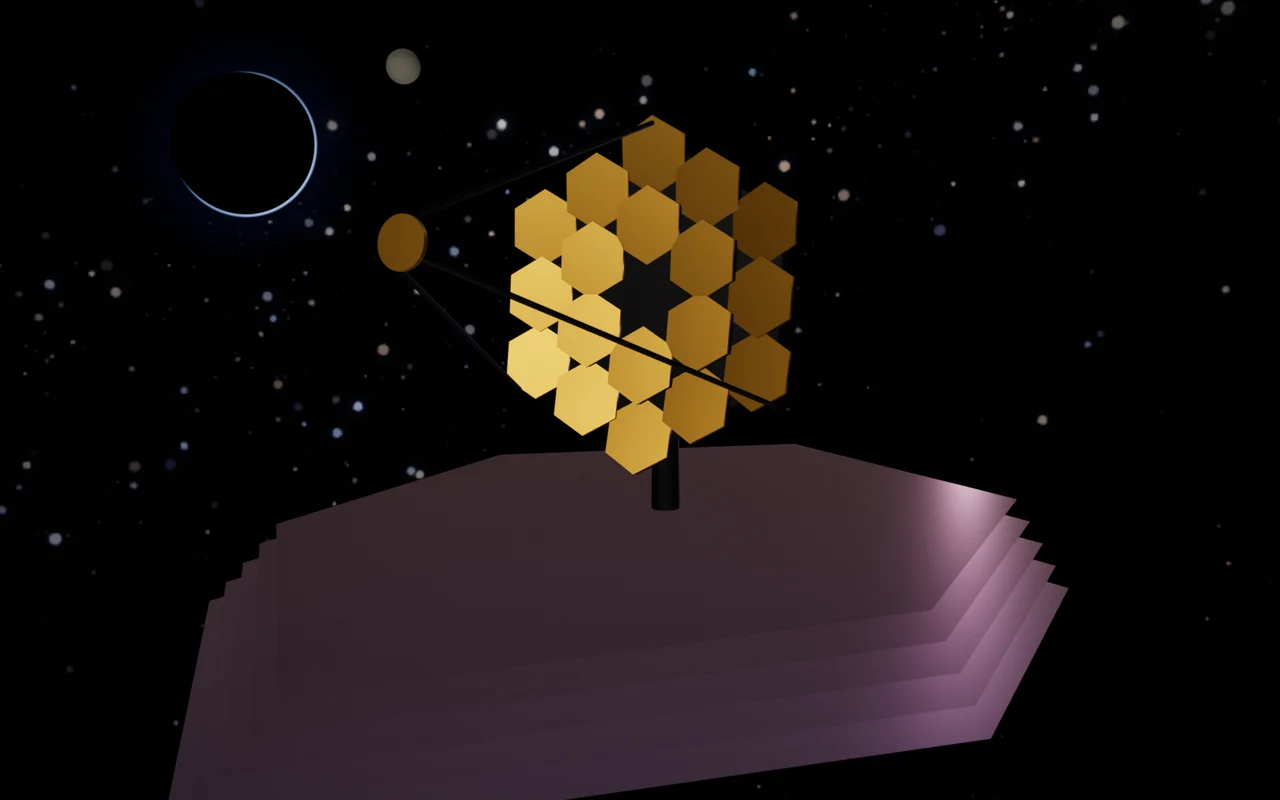
Image: Virtual Lab (3D illustration)
The James Webb Space Telescope is a joint project of NASA and the European and Canadian space agencies. Its 6.5-metre primary mirror is made of 18 hexagonal beryllium segments coated with a thin layer of gold. Too big to fit in a rocket, it was launched folded up.
In the 30 days after launch, the telescope completed hundreds of complex deployment steps. Its five-layer, tennis-court-sized sunshield unfurled, then the mirror's 'wings' swung into place, with engineers on Earth monitoring and controlling every step.
On 24 January it fired its thrusters for almost five minutes, adding just 1.6 metres per second — walking pace — to its speed. That was enough to place it in orbit around L2, which it circles roughly once every six months.
At L2, the Sun, Earth and Moon always stay on one side of the telescope, so the sunshield blocks their heat and keeps the mirror below −220 °C — cold enough to detect faint infrared light. Over the following months the 18 mirror segments were aligned to within nanometres of one another.
 Try it in the labRocket engine3D lab on this site →Share on Telegram
Sources: NASA Webb blog · Spaceflight Now