Parker Solar Probe enters the Sun's corona — the first spacecraft to 'touch' the Sun
The result was announced on 14 December 2021; the probe entered the corona on 28 April 2021.
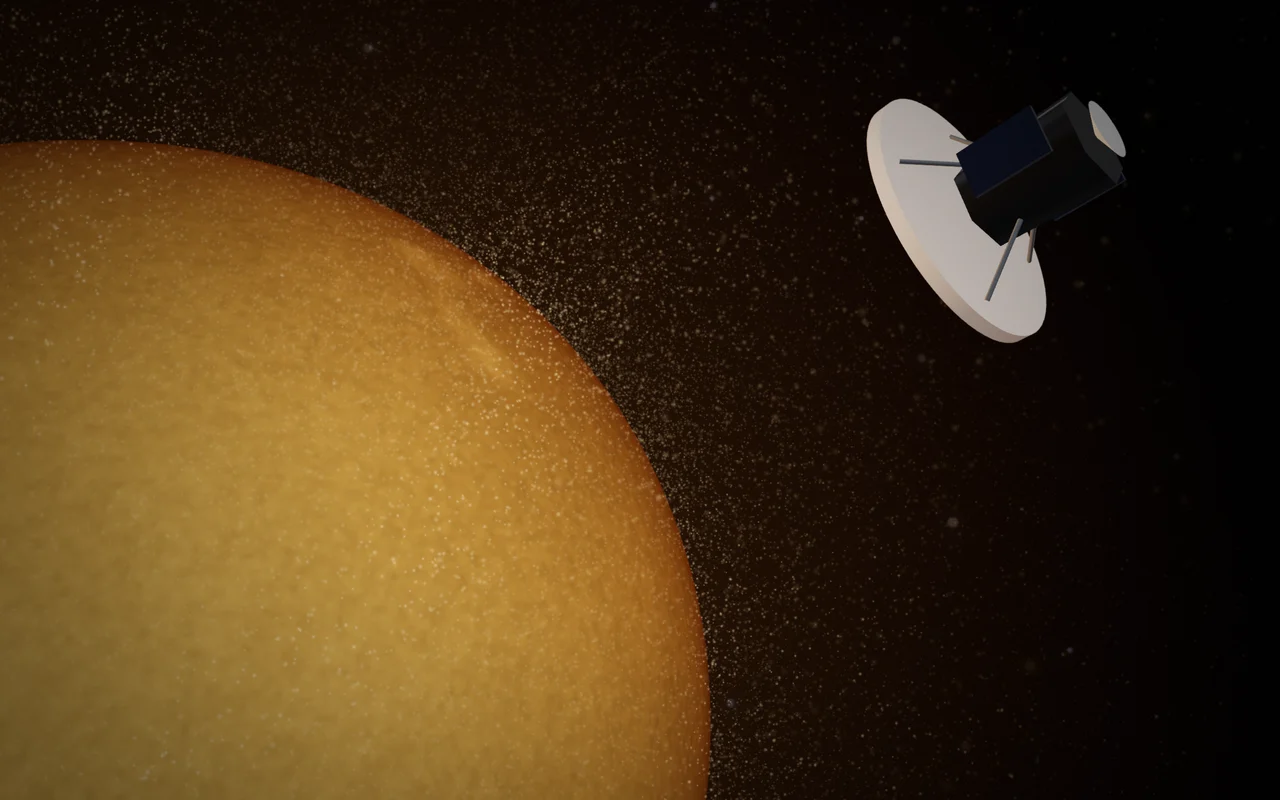
Image: Virtual Lab (3D illustration)
The corona is a thin but extremely hot layer of plasma around the Sun — over a million degrees, hundreds of times hotter than the surface, for reasons not fully understood. From it blows the solar wind, a constant stream of charged particles.
Close to the Sun, plasma is tied to its magnetic field and moves with it; farther out, the wind speeds up until the field can no longer hold it. That boundary, the Alfvén surface, marks the outer edge of the corona. On 28 April Parker dipped below it, about 13 million kilometres from the Sun's centre.
The probe's front carries an 11.4-centimetre carbon-foam heat shield that withstands about 1,400 °C while instruments behind it stay near room temperature. Inside the corona, Parker found denser plasma and a stronger magnetic field.
Parker also traced sharp S-shaped kinks in the solar wind's magnetic field — 'switchbacks' — to the edges of boiling cells on the Sun's surface. In later years it flew even closer, becoming the fastest human-made object in 2024.
 Try it in the labPlasma ball3D lab on this site →Share on Telegram