2021 Nobel Prize: climate models and the physics of complex systems
The prize was announced on 5 October 2021: half to Manabe and Hasselmann, half to Parisi.
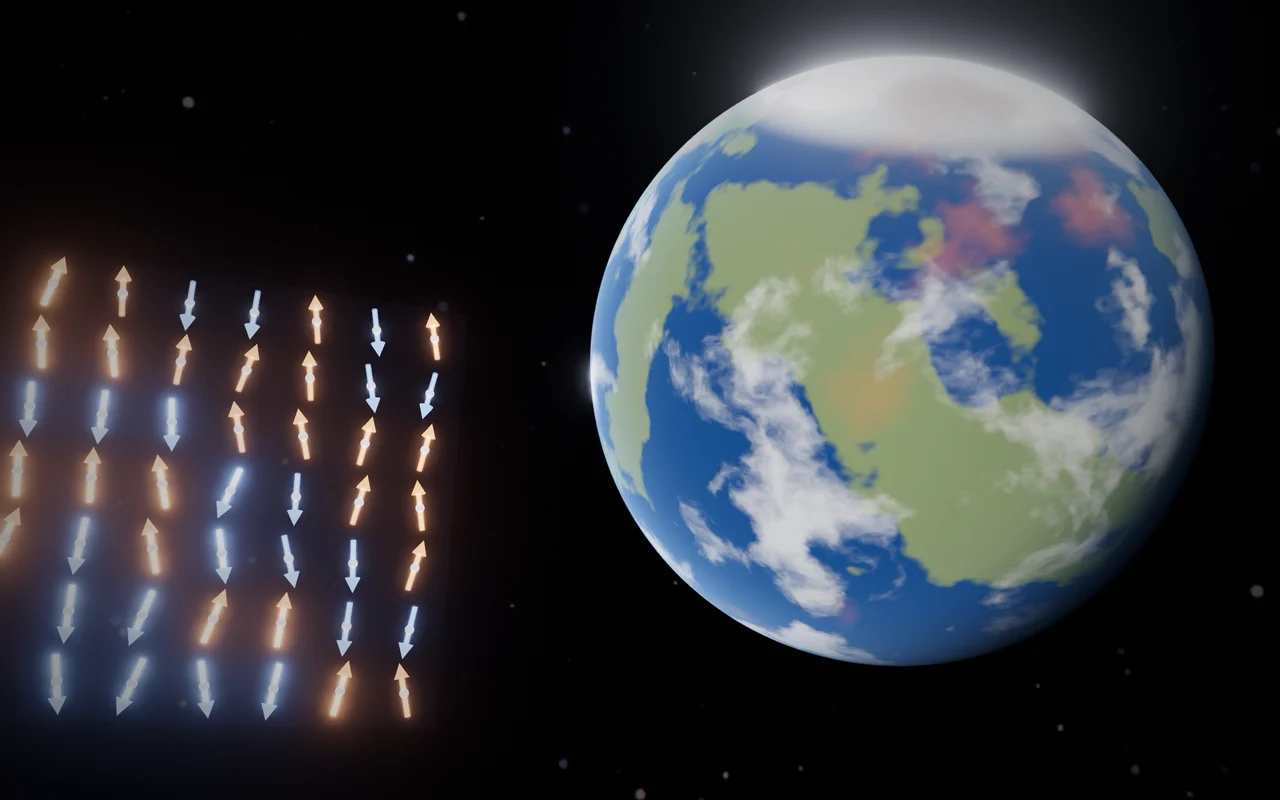
Image: Virtual Lab (3D illustration)
Climate is a highly complex system in which atmosphere, oceans, ice and land all interact. In the 1960s Manabe built one of the first physical models combining sunlight, heat radiation and rising air; his calculations showed that more carbon dioxide in the air warms Earth's surface.
About a decade later Hasselmann created a model linking fast-changing weather to slowly changing climate, showing that climate can be reliably predicted even though weather is chaotic. He also developed methods for finding the 'fingerprints' of human activity in climate change.
Around 1980 Parisi studied strange materials called spin glasses, in which the tiny magnets of atoms pull against each other and can never settle into one order. He found a mathematical method revealing hidden patterns even within such disorder.
Parisi's methods are now used far beyond physics — in neural networks, biology and even in understanding how flocks of birds move together. The Nobel committee stressed that these discoveries show our knowledge of the climate rests on a solid scientific foundation.
 Try it in the labBrownian motion3D lab on this site →Share on Telegram
Sources: NobelPrize.org · NobelPrize.org