BICEP/Keck sets the tightest limit yet on gravitational waves from the Big Bang
The result was published in Physical Review Letters on 4 October 2021.
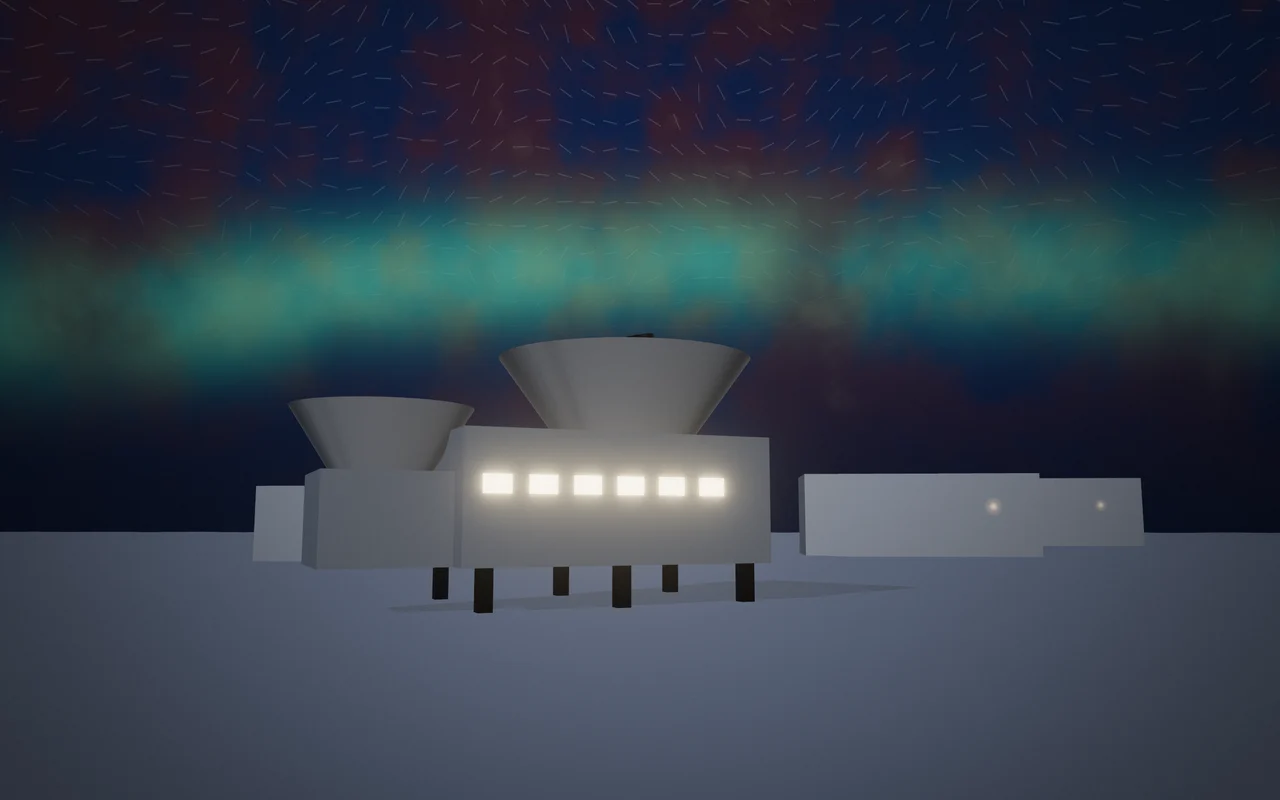
Image: Virtual Lab (3D illustration)
The cosmic microwave background is light released when the universe was about 380,000 years old. Today it fills the whole sky evenly, like the glow of a blackbody at −270 °C, and tiny differences in its temperature and polarisation reveal much about the early universe.
Many scientists think that in a tiny fraction of a second after the Big Bang the universe expanded unimaginably fast — inflation. If so, it left gravitational waves that should have drawn a distinctive swirling pattern, called a 'B-mode', in the background's polarisation.
In 2014 the BICEP2 team announced it had found that pattern, but most of the signal later proved to come from dust in our galaxy. The team then observed at three frequencies (95, 150 and 220 GHz) to separate dust from the background.
Analysis of all data through 2018 showed the gravitational waves are weaker than 3.6% of the density waves (r < 0.036) — twice as strict as before — so the simplest and most popular models of inflation no longer fit the data.
 Try it in the labThermal radiation3D lab on this site →Share on Telegram
Sources: APS Physics · PRL (DOI)