Cygnus X-1, the first black hole ever found, is much heavier than thought
The result was published in Science on 18 February 2021, in work led by James Miller-Jones.
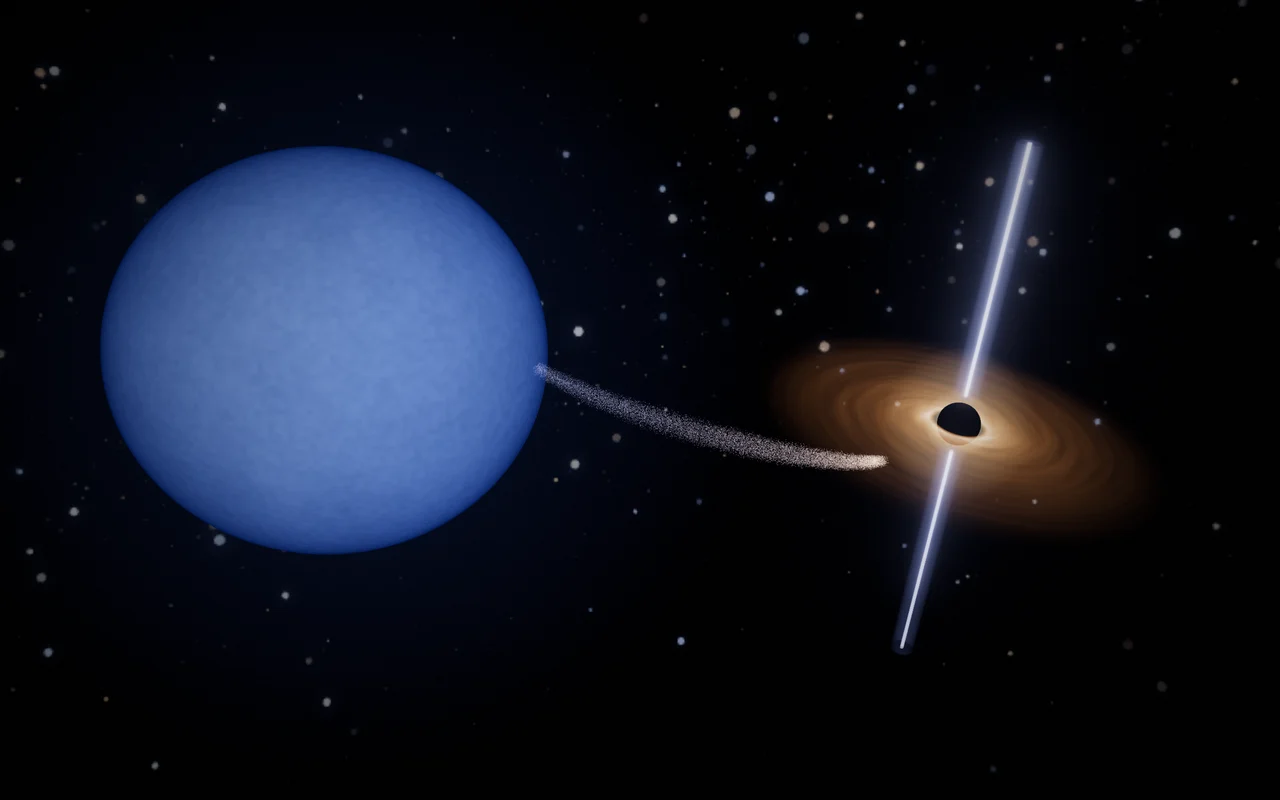
Image: Virtual Lab (3D illustration)
Cygnus X-1 was discovered in 1964 as a strong X-ray source and became the first object accepted as a black hole. Stephen Hawking even bet his friend Kip Thorne that it was not one, conceding in 1990.
The black hole orbits very close to its companion, the blue supergiant HDE 226868, pulling gas from it that heats up and emits X-rays. To find the black hole's mass you need the companion's speed — measured from the Doppler shift of its spectral lines — and the distance to the system.
Using the VLBA, a network of 10 radio telescopes across the Earth, the team measured the system's tiny wobble on the sky — its parallax. The distance came out at 7,200 light years rather than 6,100. With that, the luminosity and masses rose too: about 21 solar masses for the black hole and about 40 for the star.
The black hole was also found to be spinning close to the maximum possible rate. For such a heavy black hole to form in the Milky Way, its parent star must have lost less mass during its life than expected.
 Try it in the labThe Doppler effect3D lab on this site →Share on Telegram
Sources: EarthSky · Science News