A magnetar's giant flare pinned to a neighbouring galaxy
The results were published on 13 January 2021 in Nature and Nature Astronomy; the event is catalogued as GRB 200415A.
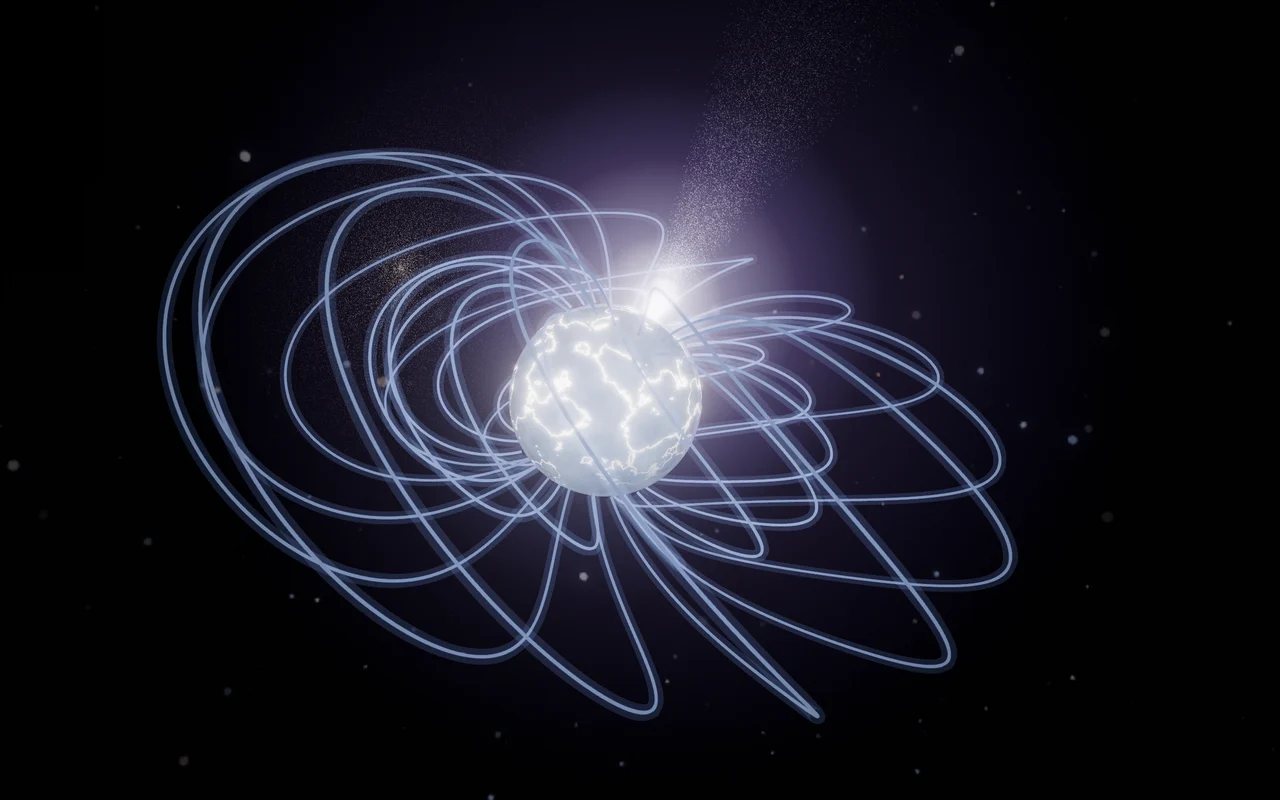
Image: Virtual Lab (3D illustration)
A magnetar is a city-sized neutron star left after a massive star explodes. Its magnetic field is trillions of times stronger than Earth's. Sometimes the field abruptly rearranges and cracks the star's crust, releasing a giant flash of gamma rays in a fraction of a second.
The Milky Way has 29 known magnetars, but only two have produced giant flares. In our own galaxy such flares are so bright they 'blind' instruments, while one in a distant galaxy looks much like an ordinary short gamma-ray burst, making the two hard to tell apart.
The 15 April signal reached different spacecraft at different times — Mars Odyssey at Mars, and Fermi, Swift and Wind near Earth. Comparing the delays narrowed the source to a tiny patch of sky lying on the central disc of NGC 253 in the constellation Sculptor.
The flare lasted only 140 milliseconds, with brightness changes faster than a millisecond, pointing to a very compact, rapidly spinning source. It is the most precise position yet for a magnetar beyond our galaxy.
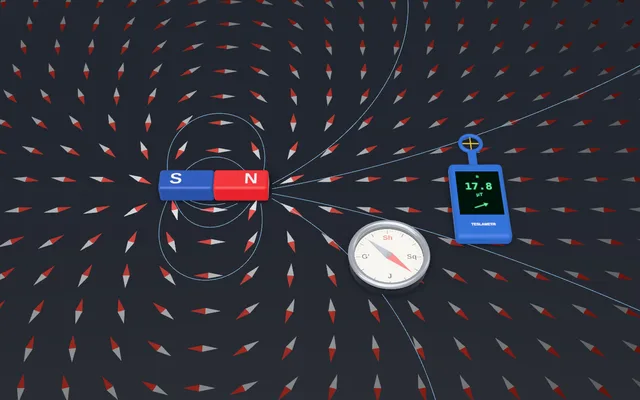 Try it in the labMagnetic field3D lab on this site →Share on Telegram
Sources: NASA · Nature (DOI)