2020 Nobel Prize: black holes
The prize was announced on 6 October 2020. Andrea Ghez became the fourth woman to win the Nobel Prize in Physics.
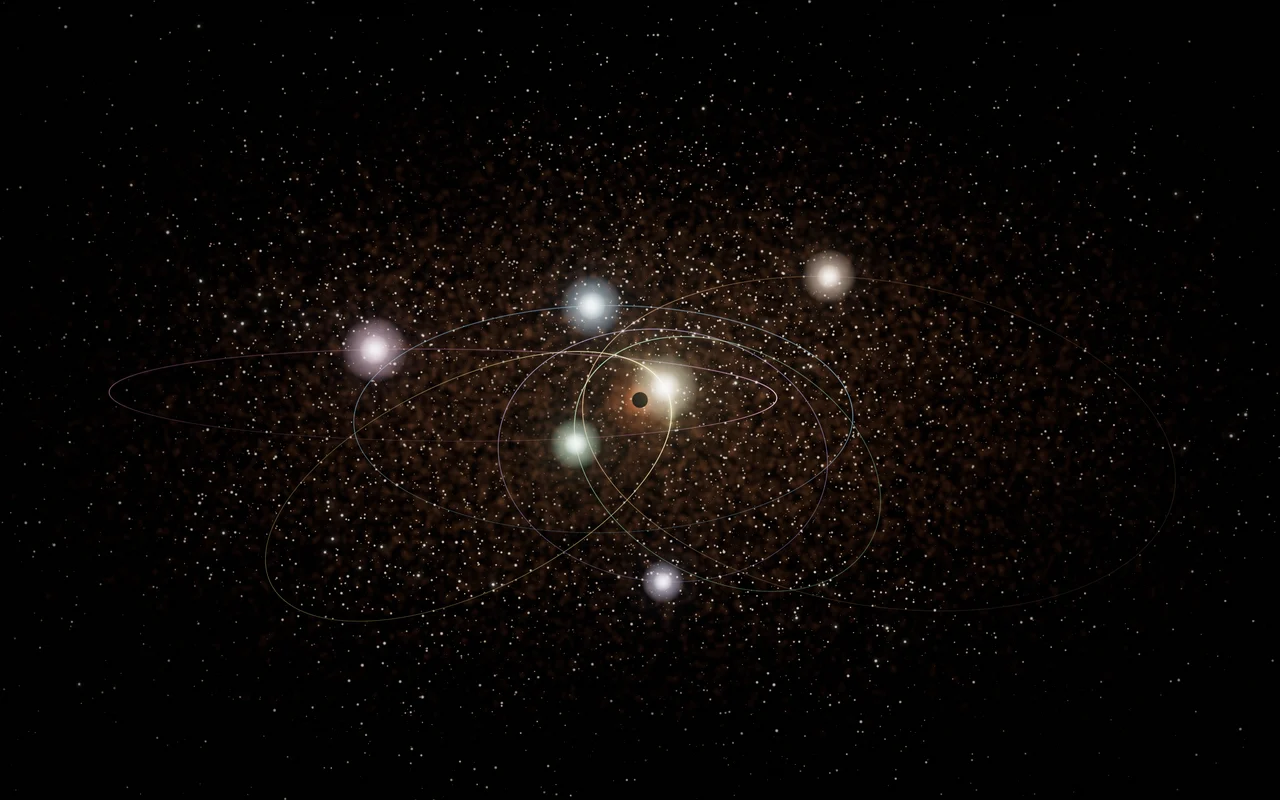
Image: Virtual Lab (3D illustration)
Einstein's general relativity allowed black holes, but Einstein himself doubted they really existed. Many believed they could form only under ideal, perfectly symmetric conditions.
In 1965 Roger Penrose used new mathematical methods to prove otherwise: squeeze enough matter together and a black hole forms inevitably, whatever its shape, with a point at its centre where the laws of physics break down.
From the early 1990s, teams led by Genzel and Ghez tracked stars at the centre of our galaxy. They used the world's largest telescopes and infrared light, which passes through dust clouds, and developed ways to remove the blurring caused by the air.
The stars turned out to orbit an invisible point just as planets orbit the Sun; the star S2 completes a lap every 16 years. From the orbits, the scientists worked out that 4 million solar masses are packed into a region smaller than our solar system. Only a black hole can explain that.
 Try it in the labArtificial satellite3D lab on this site →Share on Telegram
Sources: Nobel Prize · Nobel Prize — press release