Home › Nobel Prize laureates › 2020

Reinhard Genzel
born 1952 · Germany
Prize motivation“for the discovery of a supermassive compact object at the centre of our galaxy”
Shared the prize with: Roger Penrose, Andrea Ghez
The discovery
The centre of the Milky Way lies about 26,000 light years away behind thick clouds of dust. It cannot be seen in ordinary light, but infrared light passes through the dust.
From the early 1990s, teams led by Reinhard Genzel and Andrea Ghez observed stars at the centre with the world's largest telescopes, developing and refining methods to remove the blurring caused by the air.
The stars turned out to orbit an invisible point just as planets orbit the Sun; the star S2, for example, takes 16 years per lap. From the orbits the scientists worked out that 4 million solar masses are packed into a region smaller than our solar system — explainable only by a supermassive black hole.
Life
Born in 1952 in Bad Homburg, Germany, he earned his doctorate at the University of Bonn in 1978 and worked at Berkeley in the USA.
Since 1986 he has directed the Max Planck Institute for Extraterrestrial Physics in Garching, Germany, while also being a professor at the University of California, Berkeley. His team observed with the European Southern Observatory's Very Large Telescope in Chile.
Where it is used today
The black hole at our galaxy's centre has become the nearest “natural laboratory” for testing Einstein's theory in extremely strong gravity.
“Adaptive optics”, which corrects for the air's shimmer, is now used on all large telescopes and in medicine for sharp images of the retina.
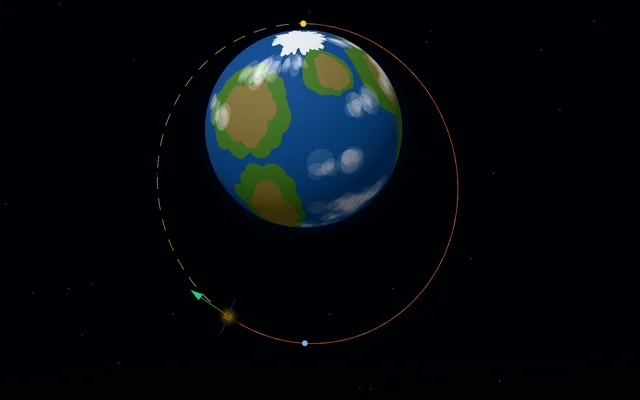 Try it in the labArtificial satellite3D lab on this site →Share on Telegram
Sources: NobelPrize.org — 2020